|
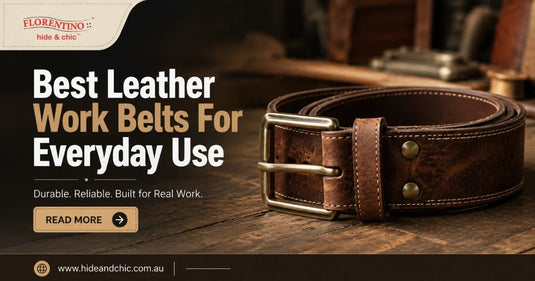
The best leather work belts are made from thick full grain leather, around 35 to 40mm wide and 3 to 4mm thick, with a solid, simple buckle. That combination holds its shape under load, survives daily wear, and lasts for years, which is exactly what a work belt needs to do. |
A work belt has the hardest job of any belt you own. It gets pulled on, sweated into, dragged against benches and doorframes, and asked to hold a waistband steady while you bend, lift and climb all day. Most belts are not built for that, which is why so many work belts give up within a year.
Good leather work belts are a different thing entirely. Get the material, width and buckle right, and you buy a belt once, not every summer. Here is what actually matters, and what to ignore.
What Makes A Good Work Belt
Three things separate a belt that survives a worksite from one that frays and folds. Everything else is detail.
• Material: Full grain leather, the top layer of the hide with the grain intact. It is the strongest grade and the only one we would trust on a work belt. Our full grain leather work belts are cut from solid hide, not layered or bonded.
• Thickness: A work belt needs body. Around 3 to 4mm thick leather resists stretching and holds its shape under load, where a thin dress belt would sag and curl.
• The Buckle: Simple and solid beats clever and hollow. A single prong in a heavy cast buckle has almost nothing to break, which is exactly what you want when the belt is a tool.

Width And Thickness: Get This Right
Width is where people go wrong. A slim dress belt looks lost on work trousers and wears out fast because all the load runs through a narrow strip.
For men's leather work belts, aim for 35 to 40mm wide. That spreads the load, fills a work trouser loop properly, and simply looks right with heavier clothing. Check your belt loops first, since a 40mm strap will not pass through a 35mm loop.
Thickness matters just as much. Thin leather folds and creases at the buckle within weeks of hard use. A thicker strap, around 3 to 4mm, stays flat, holds its shape, and takes the daily strain without complaint.
Why Full Grain Leather Wins At Work
You will see belts labelled genuine leather or bonded leather at tempting prices. On a work belt, both are false economy.
Bonded leather is ground-up scrap glued into a sheet. Under the heat, sweat and constant flexing of a working day, that glued surface separates and peels, often within months. Genuine leather sits near the bottom of the real-leather ladder and is thinner and weaker than it sounds.
Full grain is the opposite. It uses the intact top layer of the hide, so it is one dense piece with nothing to peel away. It gets a little more supple with use, develops a patina, and shrugs off the knocks. For leather belts for work, it is the only grade that makes sense.
|
Expert Insight: Durability Is A Legal Expectation, Not Just A Sales Pitch When you buy a belt described as full grain leather at a work-belt price, you are entitled to expect it to behave like one. Under Australian Consumer Law, goods must be of acceptable quality, which the ACCC defines as safe, durable and free from defects. There is no fixed rule for how long a product should last. Instead, the ACCC says durability is judged on what the product is made of, how it was made, what it cost, and any claims the seller made about it. So a premium work belt that fails in months may fall short of that guarantee, and these rights are automatic and cannot be signed away. |

Making Your Work Belt Last
Even the best for work lasts longer with a little care, and it takes minutes.
• Wipe It Down: Clear off dust, sweat and grime with a soft, dry cloth at the end of a hard week. Salt from sweat is what dries leather out.
• Condition It: Work a small amount of leather conditioner in every couple of months, or sooner if it feels dry and stiff. This keeps it supple so it flexes instead of cracking.
• Dry It Slowly: If it gets soaked, let it dry at room temperature, never against a heater. Forced drying is what causes cracking.
• Rotate If You Can: Two work belts in rotation last far more than twice as long, because the leather gets a day to recover its shape between wears.
Which Hide & Chic Belt Should You Choose?
If you want one tough belt for daily wear, a wider full grain strap with a solid buckle is the pick. If your work involves tools or the land, it is worth looking at purpose-built styles.
Our knife belts come with a leather pouch and are built for stockmen and tradespeople, and our hobble belts are heavy-duty straps made for real work. For a straightforward everyday work belt, browse the wider options across the full grain leather belt range. Selected styles run up to 60 inches, so a bigger build is not a barrier.

Buy A Work Belt Once
A proper work belt should outlast a dozen cheap ones. Browse our full grain leather belts, including tough knife belts and heavy hobble belts, all cut from solid hide and built to be used every day.
Call +61 2 9829 4084, email sales@hideandchic.com.au, or visit Unit 3B, 4 Louise Avenue, Ingleburn, New South Wales. Free shipping and Afterpay available; most orders dispatched within 24 to 48 hours, and every order is tracked.
FAQs About Leather Work Belts
Q1. What Are The Best Leather Work Belts Made From?
Full grain leather, the top layer of the hide with the grain intact. It is the strongest grade; it does not peel the way bonded leather does, and it gets more supple with use. For a work belt, pair full grain with a thickness of around 3 to 4mm and a solid buckle.
Q2. How Wide Should A Work Belt Be?
Around 35 to 40mm for most men's leather work belts. That width spreads the load, fills a work trouser loop properly, and looks right with heavier clothing. Check your belt loops before buying, because a 40mm strap will not pass through a 35mm loop.
Q3. Why Do My Work Belts Keep Breaking?
Usually because they are thin or made from bonded leather. Bonded leather is glued scrap that separates under heat, sweat and flexing, often within months. A thin strap also folds and cracks at the buckle. A thick full grain belt solves both problems.
Q4. Are Full Grain Leather Work Belts Worth The Extra Cost?
For daily work, yes. A full grain belt commonly outlasts several cheap ones, so the cost per year of wear is lower. It also holds its shape, resists peeling, and looks better with age, which a bonded or thin belt never will.
Q5. How Do I Stop A Work Belt Drying Out?
Wipe off sweat and dust with a dry cloth, then work in a little leather conditioner every couple of months. Salt from sweat is the main culprit, so regular cleaning matters. If it gets wet, dry it at room temperature, never against a heater.
Q6. What Is The Best Leather Belt For Work With Tools?
A purpose-built style. A knife belt with a leather pouch, or a heavier hobble belt, is made to carry and take punishment. For general work without tools, a wide full grain strap with a solid single prong buckle is the most reliable everyday choice.