|
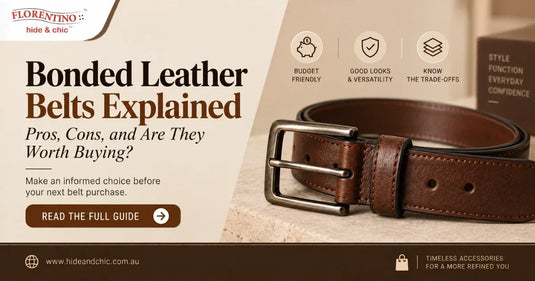
Bonded leather belts are made from leather scraps ground into a pulp, glued together and coated to look like real leather. They are cheap, but the surface peels and cracks, often within a year. For a belt you want to keep, full grain leather is a far better buy than bonded. |
You find a leather belt at a price that seems too good to be true, and often it is. The word bonded is doing a lot of quiet work on that label, and it is the single biggest reason belts end up peeling into flakes on your trousers.
So let us be straight about bonded leather: what it actually is, the few genuine pros, the serious cons, and whether it is ever worth buying.
What Are Bonded Leather Belts?

Bonded leather is to real leather roughly what chipboard is to solid timber.
When leather is cut and worked, it leaves behind scraps and fibre dust. Bonded leather takes those leftovers, grinds them into a pulp, mixes them with glue, and rolls the result into a sheet on a fabric or paper backing. That sheet is then embossed with a fake grain pattern and coated with polyurethane to look like genuine leather.
So there is real leather content in there, but it is reconstituted scrap held together by adhesive, not a solid piece of hide. That distinction is everything when it comes to how the belt behaves.
Is Bonded Leather Real Leather?
This is the question that trips people up, so here is a clear answer. Is bonded leather real leather? Partly, and misleadingly.
It does contain genuine leather fibres, which is how it can legally carry the word leather on the label. But it is not a solid piece of hide, and it does not perform like one. Calling it leather without explaining the construction is how a lot of shoppers end up disappointed. If a label just says leather at a very low price, it is worth asking which kind.
The Pros of Bonded Leather Belts
To be fair, bonded leather is not pointless. It has a couple of genuine advantages.
• Low Cost: It is cheap to make and cheap to buy, which is its main appeal.
• Uniform Look: The embossed surface is perfectly even, with no natural marks, if you prefer a flawless finish.
• Short-Term Use: For a belt you only need for a single occasion or a short spell, it can do the job briefly.
That is roughly where the good news ends.
The Cons, and They Are Serious
The problems with bonded leather are not minor quirks. They are built into how it is made.
• It Peels And Flakes: The coating separates from the glued core with flexing, heat and sweat, often within a year. This is the classic bonded leather failure, and it cannot be repaired.
• It Cracks: The surface is not a natural, flexible hide, so it cracks at stress points like the buckle fold.
• It Will Not Age Well: Real leather develops a patina. Bonded leather just deteriorates because there is no solid grain to soften and improve.
• It Cannot Be Restored: Once it starts flaking, conditioner does nothing, since there is no genuine grain to nourish. The belt is finished.
|
Expert Insight: Where Bonded Leather Sits On The Ladder In the bonded leather vs genuine leather question, it helps to see the whole ladder. Full grain sits at the top, using the intact grain layer. Top grain is next, lightly sanded. Genuine leather, despite the reassuring name, is a lower grade of real hide. Bonded leather sits at the very bottom, because it is not a continuous piece of hide at all. So when a belt is sold simply as leather, that word could mean any rung on that ladder. The Australian Consumer Law requires goods to be of acceptable quality, and the ACCC notes that any claims a seller makes about a product feed into what a reasonable buyer can expect. A premium-priced belt described as leather that peels within months is worth raising with the seller. |
Are Bonded Leather Belts Worth Buying?

For almost everyone, no. If you want a belt you will wear regularly and keep for years, bonded leather is a false economy. It looks fine on day one and disappoints within a year, so the cost per year of wear is actually high.
The best leather for belts is full grain, cut from a solid piece of hide. It costs more upfront, but it lasts many times longer, ages beautifully, and never flakes apart. If your budget is tight, a single good full grain belt beats replacing bonded belts again and again.
Every belt we sell is full grain for exactly this reason. When you shop for leather belts online with us, peeling is not a conversation we have with our customers.
Buy Once, Not Every Year

A bonded leather belt is cheap until you count how often you replace it. Shop full grain leather belts online with us instead, cut from solid hide and built to last for years with simple care, in black and brown.
Call +61 2 9829 4084, email sales@hideandchic.com.au, or visit Unit 3B, 4 Louise Avenue, Ingleburn, New South Wales. Free shipping and Afterpay available; most orders dispatched within 24 to 48 hours.
FAQs About Bonded Leather Belts
Q1. Is Bonded Leather Real Leather?
Partly. Bonded leather contains genuine leather fibres, ground-up scraps glued into a sheet, which is why it can carry the word leather. But it is not a solid piece of hide and does not perform like one. Calling it leather without explaining the construction misleads many shoppers.
Q2. Why Do Bonded Leather Belts Peel?
Because a bonded belt is a glued core with a thin coating on top, and that coating separates from the core with flexing, heat and sweat. The result is peeling and flaking, often within a year. It cannot be repaired, because the failure runs through the whole material.
Q3. Are Bonded Leather Belts Worth Buying?
For regular wear, no. They are cheap but peel and crack within a year and cannot be restored, so the real cost per year of wear is high. If you want a belt to keep, a full grain leather belt lasts many times longer and is the better value overall.
Q4. What Is The Difference Between Bonded Leather And Genuine Leather?
In bonded leather vs genuine leather, genuine leather is a lower grade of solid real hide, while bonded leather is ground-up scrap glued into a sheet. Genuine leather is a continuous piece of leather; bonded is reconstituted. Both sit below full grain, which is the strongest grade.
Q5. What Is The Best Leather For Belts?
Full grain leather. It uses the intact top layer of the hide, so it is the strongest grade, resists peeling and ages into a patina. It costs more than bonded or genuine grades, but it lasts many times longer, which makes it the best value for a belt you want to keep.
Q6. How Can I Tell If A Belt Is Bonded Leather?
Check the cut edge. Bonded leather shows a uniform core under a thin surface film, sometimes with a fabric layer visible, while full grain shows a dense, fibrous edge. Be wary of a perfectly even grain, the plain word leather at a very low price, and any early signs of flaking.