|
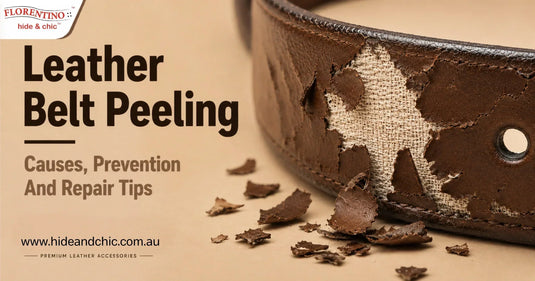
Leather belt peeling nearly always means the belt is not solid leather. Bonded leather, made from ground-up scrap glued into a sheet, separates from its backing with flexing, heat and sweat. Real full grain leather does not peel. It can crack if badly neglected, but it never flakes away in sheets. |
You notice it in the car. A small pale fleck on your trousers. Then another. By the end of the month there's a bald patch behind the buckle and your belt is quietly disintegrating onto your lap.
Here's the part nobody tells you, and it's worth knowing before you spend money trying to fix it: leather belt peeling is almost never a care problem. It's a material problem, and it was decided before you bought the thing.
The Main Cause: It Was Never Solid Leather
Real leather does not peel. That's the whole thing in one sentence.
Leather is one dense sheet of interwoven fibre. There's no separate surface layer to come away, because the surface is the material. It can dry out and crack if you neglect it badly enough, and it will darken with age. But it cannot flake off in shards, because there's nothing to flake off from.
What peels is bonded leather. Offcuts are ground into a pulp, mixed with adhesive, rolled onto a fabric backing, embossed with a fake grain and coated with polyurethane. It's the chipboard of the leather world. That coating is glued to a core, and glue plus daily flexing plus body heat plus sweat eventually loses.
Bonded leather peeling isn't a defect in the sense of something going wrong. It's the material behaving exactly as its construction dictates.

Leather Belt Peeling Causes, Ranked
If your belt is flaking, one of these explains it. They're listed by how often we see them.
• Bonded Or Coated Material: The overwhelming cause. A glued core with a surface film that separates. No amount of care prevents this.
• A Heavy Surface Finish: Even on real leather, a thick pigmented or plasticised topcoat can crack and lift. The leather underneath is sound, but the coating is not.
• Sweat And Body Heat: Salt and warmth attack adhesives. A belt lives against your body all day, which is a hard environment for anything glued.
• Repeated Flexing: The buckle fold bends thousands of times. Layered construction fails there first, every time.
• Moisture Cycling: Getting damp then drying repeatedly stresses any bond. Forced drying against a heater makes it far worse.
Only the last three are about how the belt is used, and none would matter if the first two weren't true.
Can You Fix A Peeling Belt?
Search for how to fix peeling belt damage and you'll find plenty of confident advice. Straight answer: not properly. We'd rather tell you that than sell you hope.
Once bonded leather starts separating, the bond has failed across the whole piece, not only where you can see it. Glue a flake down and it lifts again beside your repair within weeks. Trim and paint over it and you get a few cosmetic months. Neither addresses the cause, because the cause is the belt.
To fix a peeling belt in any lasting sense you'd have to replace the material, which means replacing the belt. If the buckle is good, a leatherworker can sometimes fit it to a new solid strap.
|
Expert Insight: Your Consumer Rights Still Apply A peeling belt is not automatically bad luck. Under Australian Consumer Law, goods sold to consumers must be of acceptable quality, which the ACCC explains as safe, durable and free from defects. There are no set rules for how long a product should last. Instead, the ACCC says the assessment weighs what the product is made of and how it was made, what it cost, and any claims the business made about it. So a belt sold at a premium and described as leather that flakes apart within months is worth raising with the seller. A very cheap belt sold with no durability claims sits differently. Either way, these guarantees are automatic and a store policy cannot remove them. |
How To Avoid Buying A Belt That Peels
Four checks, about ten seconds each.
• Read The Cut Edge: This is the giveaway. Real leather shows a dense, fibrous edge. Bonded shows a uniform core with a thin skin, sometimes with fabric visible. A grain can be printed. Edge structure cannot.
• Treat Genuine Leather As A Warning: It sounds like a compliment. It sits near the bottom of the real-leather ladder. Look for full grain instead.
• Distrust A Perfect Grain: Real hide varies. If the pattern repeats identically along the strap, it was stamped.
• Watch The Price: There's a floor below which real full grain leather cannot be made and sold at a profit. A very cheap belt is telling you something.
Every belt in our full grain leather range is cut from solid hide, which is why peeling isn't a conversation we have with our customers.

Leather Belt Care Tips That Actually Matter
Assuming you've bought real leather, proper leather belt care is genuinely undemanding. It's about five minutes, four times a year.
• Wipe It Down: A soft dry cloth now and then. That's it. Skip household cleaners and soaps, which strip the oils.
• Condition Occasionally: A small amount of leather conditioner every two to three months, or sooner if it feels dry and stiff. Buff off the excess. Over-conditioning leaves leather greasy and slack.
• Dry It Slowly: If it gets soaked, let it dry at room temperature away from heaters and direct sun. Forced drying is what causes the cracking people mistake for peeling.
• Store It Straight: Hang it, or roll it loosely with the buckle in the centre. Don't fold it hard, and don't bury it in a plastic bag where it can't breathe.
• Rotate Two Belts: Giving the leather a day to recover its shape between wears genuinely extends its life. This is the most underrated of all leather belt care tips.
None of this rescues bonded leather. It simply lets real leather last the decades it's capable of.

Replace It Once, Properly
If your belt is peeling, the material has already decided the outcome, and no repair will hold. The fix is a belt cut from solid hide. Browse our full grain leather belts, available in black and brown, handcrafted and built to last for years with the simple care above.
Call +61 2 9829 4084, email sales@hideandchic.com.au, or visit Unit 3B, 4 Louise Avenue, Ingleburn, New South Wales. Free shipping and Afterpay available, most orders dispatched within 24 to 48 hours, and every order is tracked.
FAQs About Leather Belt Peeling
Q1. Why Is My Leather Belt Peeling?
Because it almost certainly is not solid leather. Bonded leather is ground-up scrap glued to a backing and coated, and that coating separates with flexing, heat and sweat. Real full grain leather has no separate surface layer, so there is physically nothing to peel away from it.
Q2. Can A Peeling Leather Belt Be Repaired?
Not durably. Once the bond starts failing it has failed throughout, so a glued-down flake simply lifts again nearby within weeks. Trimming and painting buys a few cosmetic months. If the buckle is worth saving, a leatherworker can sometimes fit it to a new solid strap.
Q3. Does Real Leather Peel?
No. Genuine full grain leather is one dense sheet of fibre with no separate coating to shed. It can dry out and crack if badly neglected, and it will darken and soften with age, but it does not flake off in shards. Flaking means a layered, glued material.
Q4. How Do I Tell If A Belt Will Peel Before Buying It?
Check the cut edge, because real leather shows a dense fibrous structure while bonded shows a uniform core under a thin film, sometimes with fabric visible. Be wary of the term genuine leather, an identically repeating grain pattern, and a price that seems impossibly low.
Q5. Can Conditioning Stop My Belt Peeling?
No. Conditioner feeds real leather fibres, but bonded leather is glue and pulp, and there is nothing there to nourish. Conditioning a peeling belt sometimes makes it worse by softening the adhesive. Save the conditioner for a belt that is actually made of leather.
Q6. Is A Peeling Belt Covered By Consumer Guarantees?
Possibly. Australian Consumer Law requires goods to be of acceptable quality, meaning safe, durable and free from defects, and the ACCC notes the assessment weighs the price, the materials and any claims made. A premium belt described as leather that flakes within months is worth raising with the seller.