|
In single vs double prong belts, the single prong is the everyday classic: quick, slim and suited to formal and casual wear alike. A double prong spreads load across two points and reads more rugged, which suits wider straps and heavier use. Most people should choose a single prong. |
Somewhere between noticing double prong buckles exist and understanding why, most people quietly assume two prongs must be twice as good. More metal, more security, obviously better.
It isn't that simple, and the answer is more about proportion than strength. So let's settle single vs double prong belts properly, including the part nobody mentions about belt loops.
What The Two Actually Are
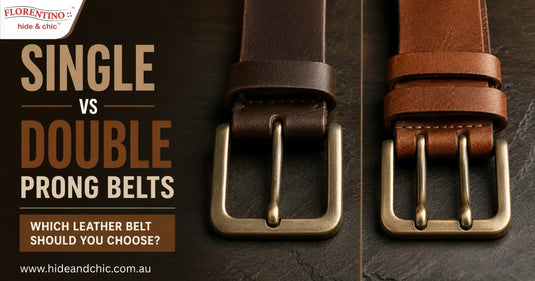
A single prong leather belt uses one pin, hinged on the buckle bar, that drops through one hole. It's the buckle almost everyone grew up with. Quick to fasten, low profile, and it disappears under a jacket.
A double prong leather belt uses two pins, side by side, dropping through two holes punched as a pair. The strap has rows of paired holes rather than single ones. The look is wider, heavier and more deliberate, and it has roots in workwear and military kit.
Both are prong buckles. Among belt buckle types you'll also meet plate buckles, ratchet or automatic buckles that skip holes entirely, and braided straps where the prong passes anywhere through the weave. But prongs are the mainstream, and this is the comparison that matters most.

Single vs Double Prong Belts: The Real Differences
Five things separate them in practice.
• Fastening Speed: A single prong is faster. One pin, one hole. A double prong needs both pins aligned with both holes, which is a two-handed job until it becomes muscle memory.
• Load Spread: A double prong spreads tension across two points rather than one. On a heavy strap carrying weight, that reduces the strain on any single hole.
• Hole Wear: Because load is shared, paired holes tend to deform more slowly than a single hole under the same tension. On a light dress belt this is largely irrelevant.
• Formality: A single prong is neutral and goes anywhere. A double prong reads casual and rugged, and looks out of place with a suit.
• Strap Width: Double prongs need width to look right, generally 38mm and up. On a slim strap the two pins crowd each other and the proportions go wrong.
|
Factor |
Single Prong |
Double Prong |
|---|---|---|
|
Pins |
One |
Two |
|
Typical Width |
28 to 40mm |
38mm and up |
|
Fastening |
Fast, one hand |
Slower, two hands |
|
Load Spread |
Single point |
Shared across two |
|
Formality |
Formal to casual |
Casual and rugged |
|
Best For |
Everyday, suits, jeans |
Workwear, heavy straps |
The Belt Loop Problem Nobody Mentions
Here's the practical catch. A double prong buckle usually sits on a wider strap, and wider straps do not fit every pair of trousers.
Plenty of chinos and dress trousers have loops sized for 35mm or less. A 40mm double prong strap simply will not pass through them, and you'll find this out while already running late. Measure a loop before you buy.
|
Expert Insight: Two Prongs Do Not Rescue Bad Leather We get asked whether a double prong buckle makes a belt last longer. On its own, no. Sharing load across two holes genuinely helps the holes, but belts rarely fail at the holes. They fail at the buckle fold, where the strap bends thousands of times, and they fail when the material itself gives way. If the strap is bonded leather, the surface will separate regardless of the hardware. Grade decides longevity. The buckle decides fit and style. |

Which One Should You Choose?
For most people, most of the time, a single prong. It's faster, it fits more trousers, it works with a suit and with jeans, and it's the reason it became the default in the first place. If you're buying one belt to do everything, this is it.
Choose a double prong if you want a deliberate, rugged look, you wear wide straps with jeans or workwear, and your loops can take the width. It's a style decision with a small functional bonus, rather than a strict upgrade.
Our full grain leather belt range covers both classic single prong styles and heavier straps, alongside ratchet buckles if you'd rather skip holes altogether.
A Note On Ratchet Buckles
Worth a mention, since it solves a different problem. A ratchet or automatic buckle has no prong at all. The strap has a hidden toothed track underneath, and the buckle clamps at whichever point you choose, adjusting in increments of roughly a quarter inch instead of a full inch.
If your gripe with prong belts is that the fit is always slightly wrong, one hole too tight and the next too loose, a ratchet buckle is a better answer than adding a second prong.

Pick The Buckle, Then Check The Leather
Buckle style is worth thinking about, but it's the second decision. The first is the strap. Browse our full grain leather belts, from slim dress belts to heavier everyday widths, all handcrafted and built to last for years with care.
Call +61 2 9829 4084, email sales@hideandchic.com.au, or visit Unit 3B, 4 Louise Avenue, Ingleburn, New South Wales. Free shipping and Afterpay available, most orders dispatched within 24 to 48 hours.
FAQs About Single vs Double Prong Belts
Q1. Is A Double Prong Belt Stronger Than A Single Prong?
At the holes, somewhat, because load spreads across two points instead of one. But belts rarely fail at the holes. They fail at the buckle fold or because the leather itself is poor. Material grade determines how long a belt lasts far more than the number of prongs does.
Q2. Can You Wear A Double Prong Leather Belt With A Suit?
It's best avoided. Double prong buckles read casual and rugged, and they usually sit on straps of 38mm or wider, which looks heavy under tailoring. For a suit, choose a slim single prong leather belt around 28 to 32mm in black or dark brown.
Q3. Are Double Prong Belts Harder To Fasten?
Slightly, at first. You need to line up two pins with two holes, which generally takes both hands. Most people stop noticing within a week or two. If speed genuinely matters to you each morning, a single prong or a ratchet buckle will suit you better.
Q4. What Width Suits A Double Prong Buckle?
Around 38mm and up. Two pins need room to sit apart without crowding, so on a slim strap the proportions look wrong. Check your belt loops first, because many chinos and dress trousers take 35mm or less and a wider strap simply will not go through.
Q5. What Are The Main Belt Buckle Types?
Single prong, double prong, plate buckles, and ratchet or automatic buckles that clamp on a hidden toothed track instead of using holes. Braided belts are a separate case, since the prong passes through the weave at any point, giving a custom fit without fixed holes.
Q6. Does A Double Prong Buckle Stop Belt Holes Wearing Out?
It slows hole deformation, because tension is shared between two holes rather than concentrated in one. That's a real if modest benefit on heavy straps under load. On a light dress belt the difference is negligible, and the choice comes down to style instead.