|
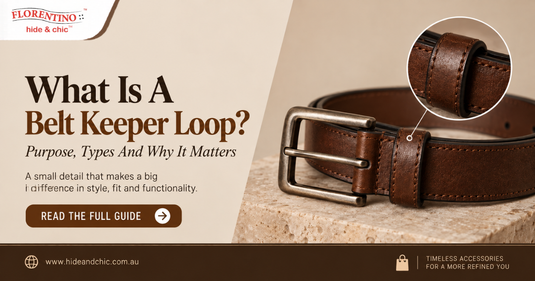
A belt keeper loop is the small loop near the buckle that holds the loose end of the belt, the tail, flat against your body after you fasten it. Its purpose is to stop the tail flapping or curling. Many belts have two loops, one fixed and one sliding, for a neater, more secure hold. |
It is one of the most overlooked parts of a belt, right up until it snaps off and the loose end starts flapping about all day. This small loop is a tiny detail that you never think about when it works and cannot ignore when it fails.
So here is what it actually does, why many belts have two of them, and how this small part quietly signals whether a belt was made with care.
What Is A Belt Keeper Loop?

A keeper loop is the small loop of leather, or sometimes metal, that sits just behind the buckle. After you fasten the belt, you tuck the loose end, known as the tail, through it.
Its whole job is to hold the tail flat and tidy against your body, so it does not stick out, curl up, or flap around as you move. Simple, unglamorous, and genuinely useful. Without it, the end of your belt has nowhere to go.
Why Do Belts Have Two Loops?
This is the question everyone asks once they start noticing. Why do belts have two loops when one seems like it would do the job?
The two loops usually play slightly different roles. One is a fixed keeper, stitched permanently into place right beside the buckle. The other is a floating or sliding keeper that can move along the strap. Together they hold the tail in two places, which keeps it flatter and more secure than a single loop can.
The fixed loop anchors the tail close to the buckle. The sliding loop can be positioned to catch the very end of the tail, wherever it happens to fall for your waist size. Two points of hold, no flapping. That is the belt keeper loop purpose, done properly.
Types Of Belt Keeper Loops
Not all keepers are the same, and the type tells you something about the belt. Here are the main types of belt keeper loops you will meet.
• Fixed Keeper: Stitched permanently in place next to the buckle. Sturdy and reliable, it is the primary loop on most belts.
• Floating Or Sliding Keeper: Loose on the strap so it can move to catch the tail end. It adds a second, adjustable point of hold.
• Matched Leather Keeper: Made from the same leather as the belt, so it looks seamless. A sign of a considered, well finished belt.
• Metal Keeper: Less common, used on some heavier or western styles, offering a rugged look and a firm hold.
On a quality belt, the keeper matches the strap in leather and finish, and it is stitched or edged as carefully as the rest. On a cheap belt, it is often an afterthought.
Add Image
Why This Small Part Matters

A keeper loop seems trivial, but it is one of the quietest quality tells on a belt, which is why it is worth a look before you buy.
Among all the belt buckle components, the keeper is where corners get cut on cheap belts. A flimsy, loose, or badly stitched keeper often means the rest of the belt was rushed too. A keeper that matches the leather, sits snugly, and is neatly stitched suggests the whole belt got proper attention.
|
Expert Insight: Check The Keeper Before You Buy When we assess a belt, the keeper loop is one of the first things we look at, because it is a fast, reliable signal. Is it the same leather as the strap, or a cheaper substitute? Is it stitched securely, or just glued? Does it sit snugly, or flop loose? A well made keeper does not prove a belt is perfect, but a poor one almost always means corners were cut elsewhere. It costs nothing to check, and it takes two seconds in a shop. This is exactly the kind of small detail that separates a belt built to last from one built to look right on a hanger. |
What To Look For In A Good Belt
The keeper is one detail in a bigger picture. When you choose a belt, run a quick check: full grain leather, tight and even stitching, a solid buckle, and keeper loops that match the strap and sit snugly.
Get those right, and you have a belt that not only lasts but stays tidy every time you wear it. Our belts are cut from full-grain leather with matched, securely fitted keepers as standard. Browse the full-grain leather belt range to see the finish up close.
Belts Made With Care, Down To The Keeper

The little details are where quality shows. Browse our full-grain leather belts, made with matched keeper loops, tight stitching and solid buckles, all built to last for years with simple care.
Call +61 2 9829 4084, email sales@hideandchic.com.au, or visit Unit 3B, 4 Louise Avenue, Ingleburn, New South Wales. Free shipping and Afterpay available; most orders dispatched within 24 to 48 hours.
FAQs About Belt Keeper Loops
Q1. What Is A Belt Keeper Loop?
A belt keeper loop is the small loop just behind the buckle that holds the loose end of the belt, the tail, flat against your body after you fasten it. It stops the tail flapping, curling or sticking out. It is usually made of the same leather as the belt strap.
Q2. Why Do Belts Have Two Loops?
Because two loops hold the tail more securely than one. Usually one is a fixed keeper stitched beside the buckle, and the other is a sliding keeper that moves to catch the very end of the tail. Together they hold it flat in two places, so it does not flap loose.
Q3. What Is The Belt Keeper Loop Purpose?
Its purpose is to keep the loose end of the belt tidy and flat after fastening. Once you buckle up, you tuck the tail through the keeper so it stays against your body instead of sticking out. It is a small part with a genuinely practical job.
Q4. What Are The Types Of Belt Keeper Loops?
The main types are a fixed keeper stitched permanently by the buckle, a floating or sliding keeper that moves along the strap, a matched leather keeper made from the same hide as the belt, and a metal keeper on some heavier or western styles. Quality belts use matched, securely fitted keepers.
Q5. Can You Replace A Broken Belt Keeper Loop?
Often yes. A leatherworker can usually make and fit a replacement keeper, especially on a good quality belt where the strap is sound. It is a small repair. On cheap belts, it may not be worth the cost, which is another reason to buy a well made belt in the first place.
Q6. Is The Keeper Loop A Sign Of Belt Quality?
It can be. Among the belt buckle components, the keeper is where cheap belts often cut corners. A keeper that matches the strap leather, sits snugly and is neatly stitched suggests care throughout. A flimsy, glued or mismatched keeper usually means the belt was rushed elsewhere too.